How To Get The Resultant Vector Using Polygon Method
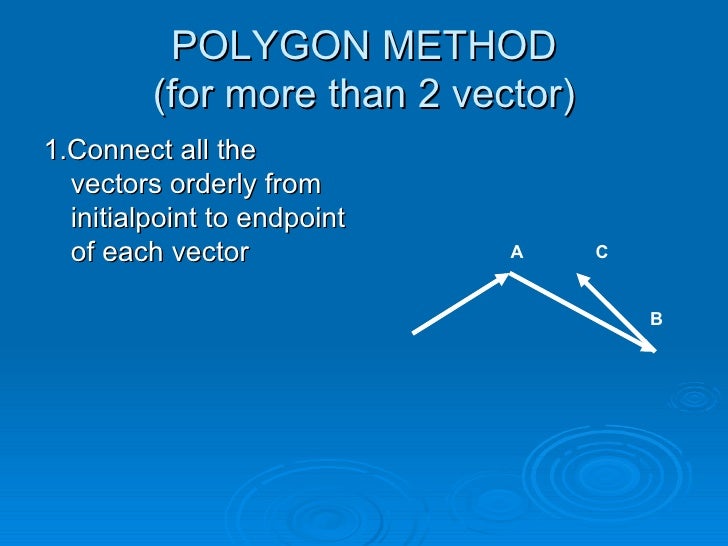
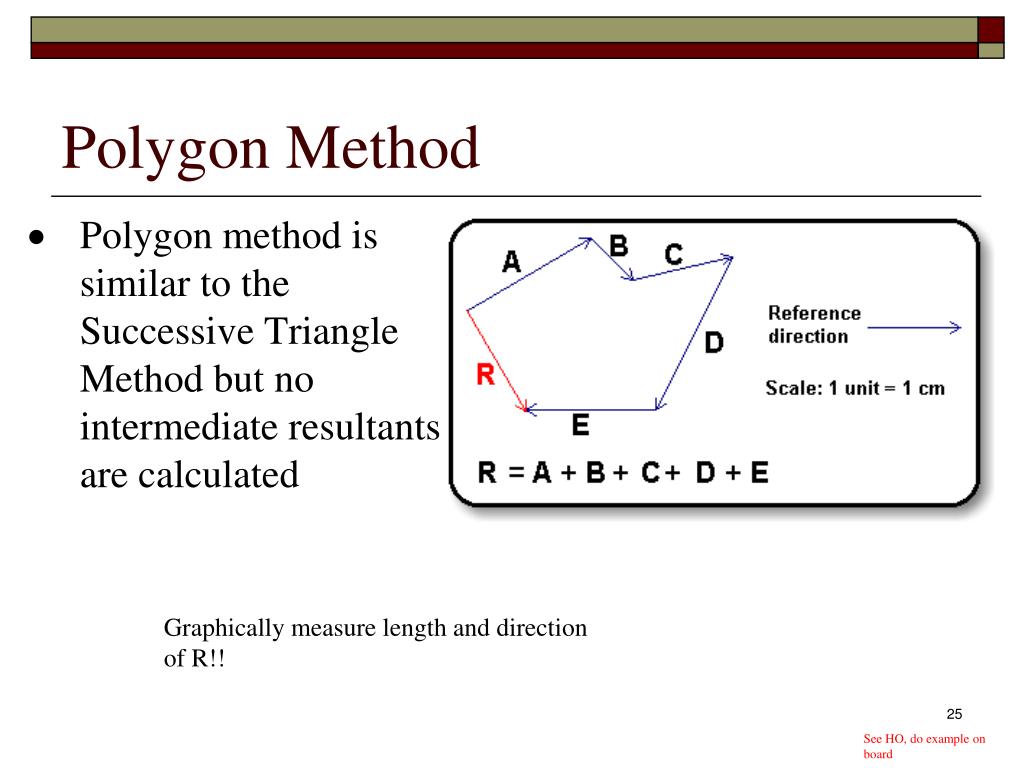
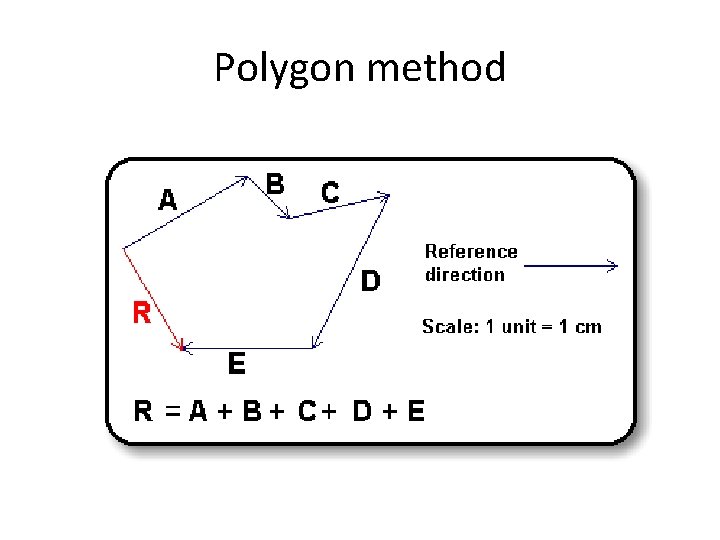
In polygon method of finding the sum or resultant of vectors vecP vecQ vecR vecS vecT are vectors are drawn from head to tail to form an open polygon as shown. Finding the resultant of three forces by the polygon method.

How To Calculate The Resultant Force Acting On An Object X Engineer Org
Starting from the first vector other vectors.

How to get the resultant vector using polygon method. 2 Three force vectors F1 F2 F3 are simmultaneously applied at point A. Polygon Method of Finding a Resultant Vector. Experiments show that when an object is subject to several forces F 1 F 2 the resultant force R is the vector sum of those forces.
The starting point A is arbitrary. Determine the coordinate system for the vectors. 100m A 600m B400m C 300m 54.
How to solve resultant vector using polygon method. Getting Vector Resultant Using Polygon Method. Figure 7 Step 5.
The graphical method involves drawing vectors in a graph and adding them using head to tail method. R 2 220 m 2 520 m 2 R 2 4840 m 2 27040 m 2 R 2 31880 m 2 R SQRT 31880 m2 2. The analytical method of vector addition and subtraction involves using the Pythagorean theorem and trigonometric identities to determine the magnitude and direction of a resultant vector.
The steps to add vectors A and B using the analytical method are as follows. The resultant vector vecR is drawn from the tail of first vector to head of the last vector. The 520 m West side is the result of 160 m West and 360 m West added together.
A 200gf at 00 B 150gf at 350 and C 250 gf at 130 As shown in the example above draw a polygon with the three given vectors A B C by placing the vectors one after another on a tail-to-tip basis. Find the x and y components of the three vectors and then add them RxAxBxCx and RyAyByCy. The starting point A is arbitrary.
Getting vector resultant using polygon method 1. The magnitude of the resultant vector R can be determined using the Pythagorean theorem. In polygon method of finding the sum or resultant of vectors PQ RST are vectors are drawn from head to tail to form an open polygon as shown.
Example 1 O Erik walks 600m East then turns 400m North and finally walks 300mWest. OverrightarrowR overrightarrowF_1 overrightarrowF_2 overrightarrowF_3 overrightarrowF_4. Draw the resultant vector by starting where the tail of first vector.
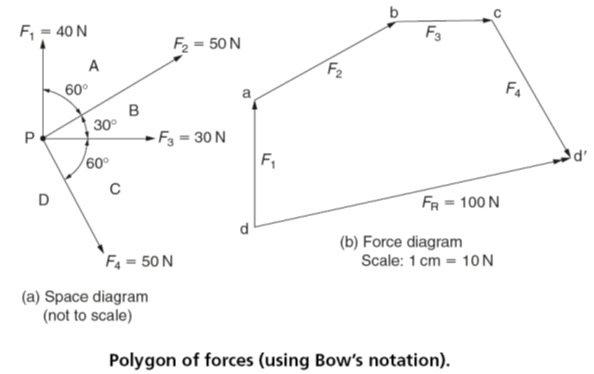
How to Find the Resultant of Three or More Vectors. Notice that this is not a mere sum of the magnitudes of the forces but the sum of the forces taken as vectors which is more involved because vectors have both a magnitude and a direction that we need to consider when doing the sum. Report your answer in vector notationDraw a Force Polygon Fx 1268 Cos937 125 Fy 1268 Sin937 207 F 125i 207j 2.
Draw an arrow from the tail of the first vector to the head of the last vector. The steps to add vectors A and B using the analytical method are as follows. In the polygon method of finding the resultant vector vectors are drawn from head to tail of each other.
1 Use the Law of Sines and Law of Cosines to determine the resultant force vector caused by the two forces shown. The steps to add vectors A and B using the analytical method are as follows. The resultant force is the vector sum between the components.
If a number of vectors are represented in magnitude and direction by the sides of an incomplete polygon taken in order then their resultant is denoted by the closing side of the polygon in magnitude and direction taken in the opposite order. How to Find the Resultant of Three or More Vectors - YouTube. Determine the coordinate system for the vectors.
Step 1Calculate the horizontal and vertical components of each force AB and C. The resultant vector R is drawn from the tail of first vector to head of the last vector. Then from the tip of A draw B.
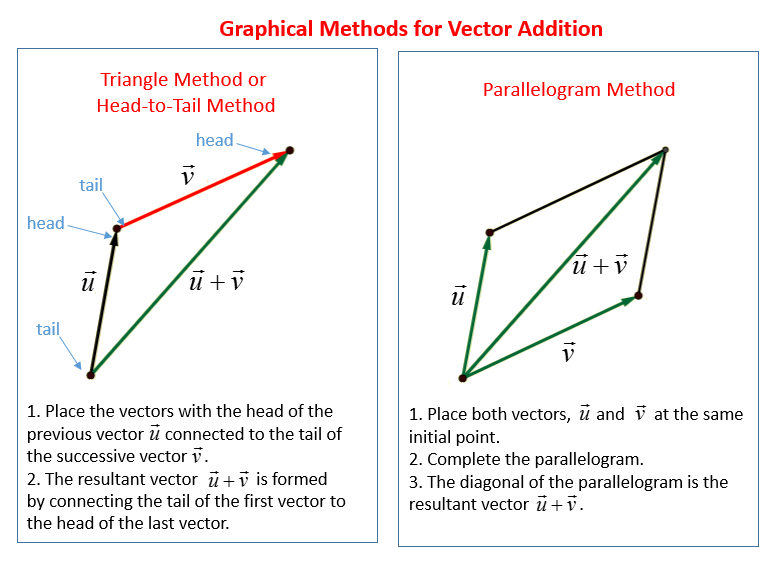
OverrightarrowR overrightarrowF_1 overrightarrowF_2 If there are several forces acting on the same point we can apply the polygon rule to find their resultant. This video shows how to find the resultant force of two vectors using the parallelogram method. Place the two vectors next to each other such that the head of the one vector is touching the tail of the other vector.
The analytical method of vector addition and subtraction involves using the Pythagorean theorem and trigonometric identities to determine the magnitude and direction of a resultant vector. Find its resultant vector. You can calculate the angle for R using Rx and Ry.
The 220 m North side is the result of 20 m South and 240 m North added together. Yes you are doing it correctly. R F 1 F 2.
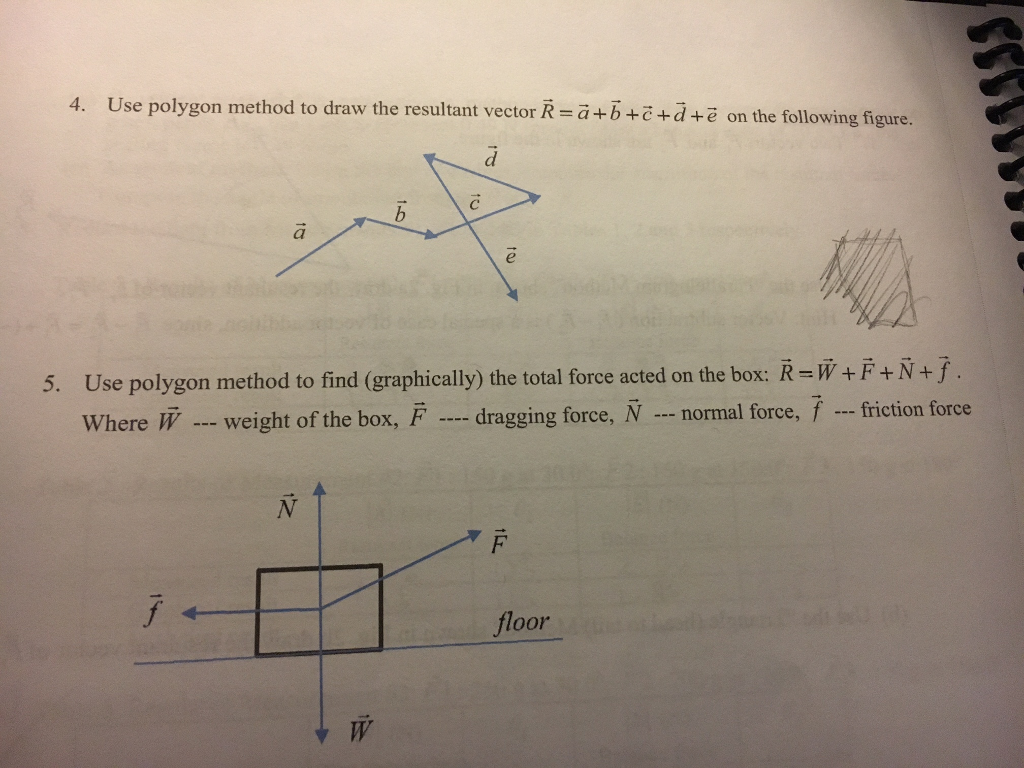
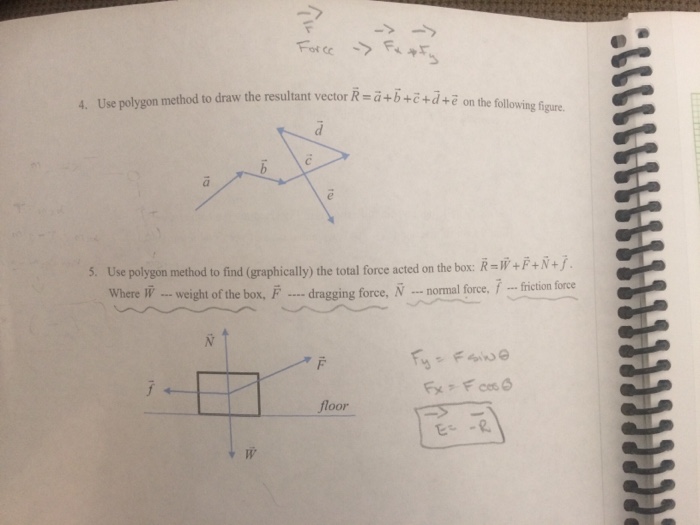
Resultant vector using trigonometric method. This is the resultant or the sum of the other vectors. Where W weight of the box F dragging force N normal force f friction force.
Then determine the horizontal and vertical components of each vector using the.
New Page 1

Vector Addition
Polygon Law Of Vector Addition Youtube

Addition Of Three Vectors Using Triangle Law And Polygon Law Youtube
Ppt Lecture 2 Ref Ch 2 Powerpoint Presentation Free Download Id 848830

Resultant Vector Parallelogram Method
Resultant Zero Physics Forums
Use Polygon Method To Draw The Resultant Vector R A Chegg Com

Resultant Of A Coplaner Concurrent Force System By Graphical Method Graphic Statics Youtube

Find The Resultant Force Using The Parallelogram Method Youtube
Vector Addition Video Lessons Examples And Solutions
Scalars And Vectors Scalars And Vectors Scalar Is

Episode 5 Polygon Method For Vector Addition Youtube
How Would You Solve Question For An Question Five Chegg Com
Chapter One

Resultant Force Vector Diagrams Of Forces Graphical Solution
New Page 1


Getting Vector Resultant Using Polygon Method

13 A Woman Walks 4 Km East And Then 8 Km North A Use The Polygon Method To Find Her Resultant Displacement B Verify The Result By The Parallelogram Method

Post a Comment for "How To Get The Resultant Vector Using Polygon Method"